
Start
US$ 6.95/mo
- 1 vCore CPU
- 1 GB Memory
- NVME 20 GB Disk
- Unlimited Traffic
 AI and agents · Rio de Janeiro or São Paulo
Qdrant is a vector database that stores embeddings and finds the content most similar to a query. It is the base for semantic search and RAG. At Mega it comes preinstalled on a VPS with Debian 13, Docker and HTTPS, in Rio de Janeiro or São Paulo, Brazil.
Qdrant keeps vectors in memory to respond quickly, so RAM determines how large your dataset can be. The app fits in as little as 512 MB of free memory, and the Basic plan is the starting point we recommend.
Billed monthly in US dollars, with the app installed. Rio de Janeiro or São Paulo, same price. Plans start at the smallest size where the app runs well. Need more? Upgrade from the client area, without reinstalling.
With Rio de Janeiro selected, your VPS with Qdrant runs in Mega's original data center, on our own network with a presence at the Rio internet exchange (IX.br) and redundant transit. It is the lowest latency for users in Rio, Espírito Santo and Minas Gerais, and our support team works in the same city as the server.
With São Paulo selected, your VPS with Qdrant runs in our environment next to the busiest internet exchange in Latin America, on our own network with redundant transit. It is the shortest path to users across Brazil and South America and to banks, payment gateways and APIs hosted in São Paulo. Same price as Rio.
Qdrant is an open-source vector database written in Rust and licensed under Apache 2.0. An AI model turns each piece of text or product into a vector, and Qdrant returns the closest matches to a query in milliseconds.
In practice, it is the component that lets an AI assistant answer from your own documents, a technique called RAG. You split the text, generate the vectors and store them in Qdrant. For each question, it hands the model the most relevant passages.
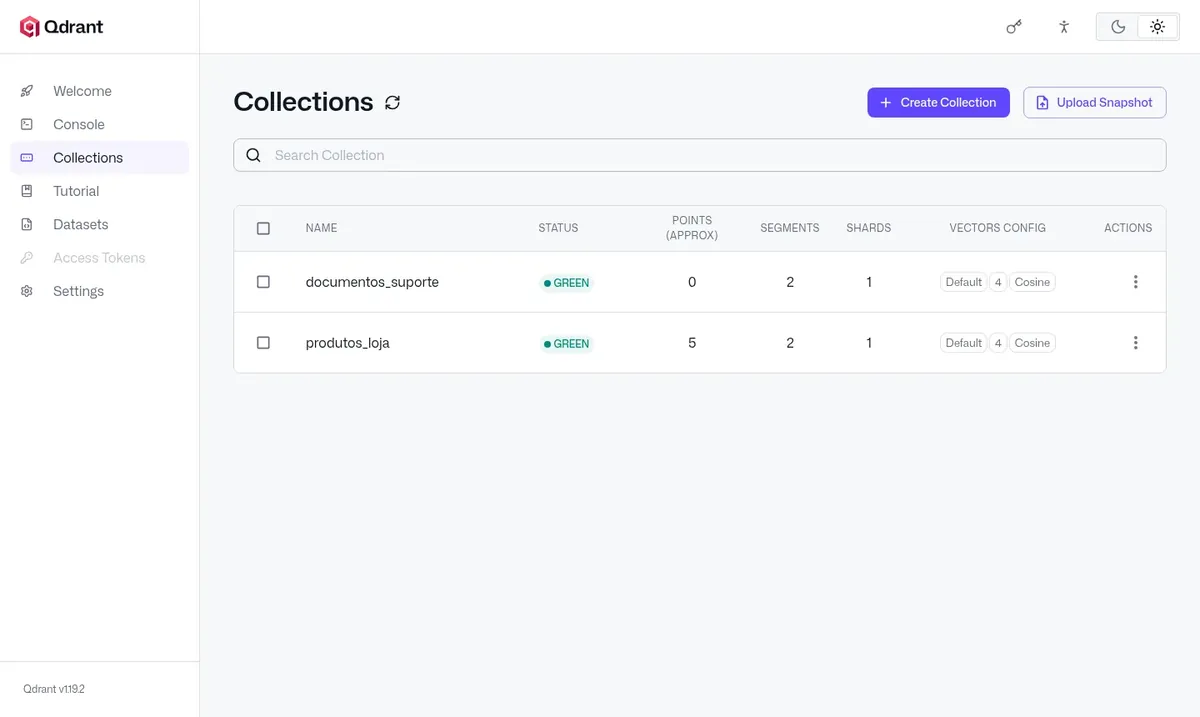
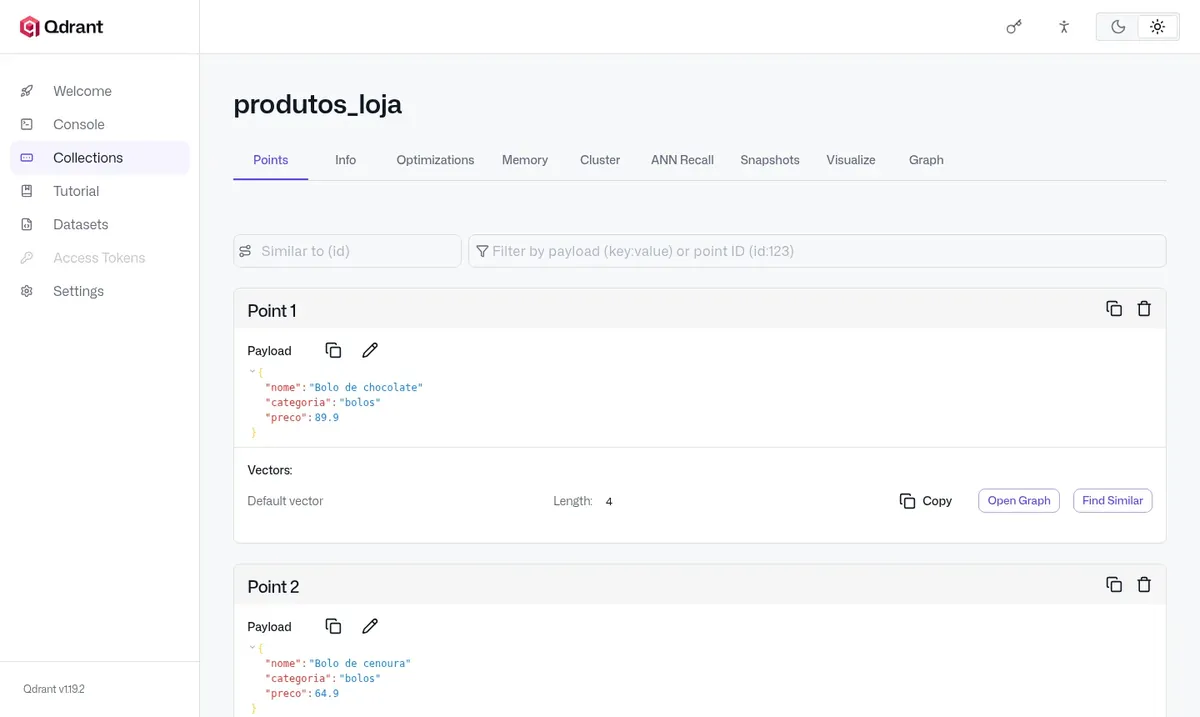
You access it through a REST or gRPC API, with filters on each item's fields (payload) and a web dashboard for browsing collections and points. In the Mega installation, both the API and the dashboard only respond to whoever has the key generated for your server.
Source: Official Qdrant repository on GitHub, accessed in October 2026
Manuals, contracts and a knowledge base feed an assistant that answers by citing the right passage.
Someone who types "gift for a 5-year-old" finds related products, even if the descriptions don't use those words.
The agent stores conversations and facts and retrieves whatever is useful when it needs it.
Suggest products, articles or courses similar to what the customer has already viewed or bought.
n8n has a Qdrant node, so you can index files and query the database inside your automation.
Spot near-identical records, tickets or texts that a regular search would miss.
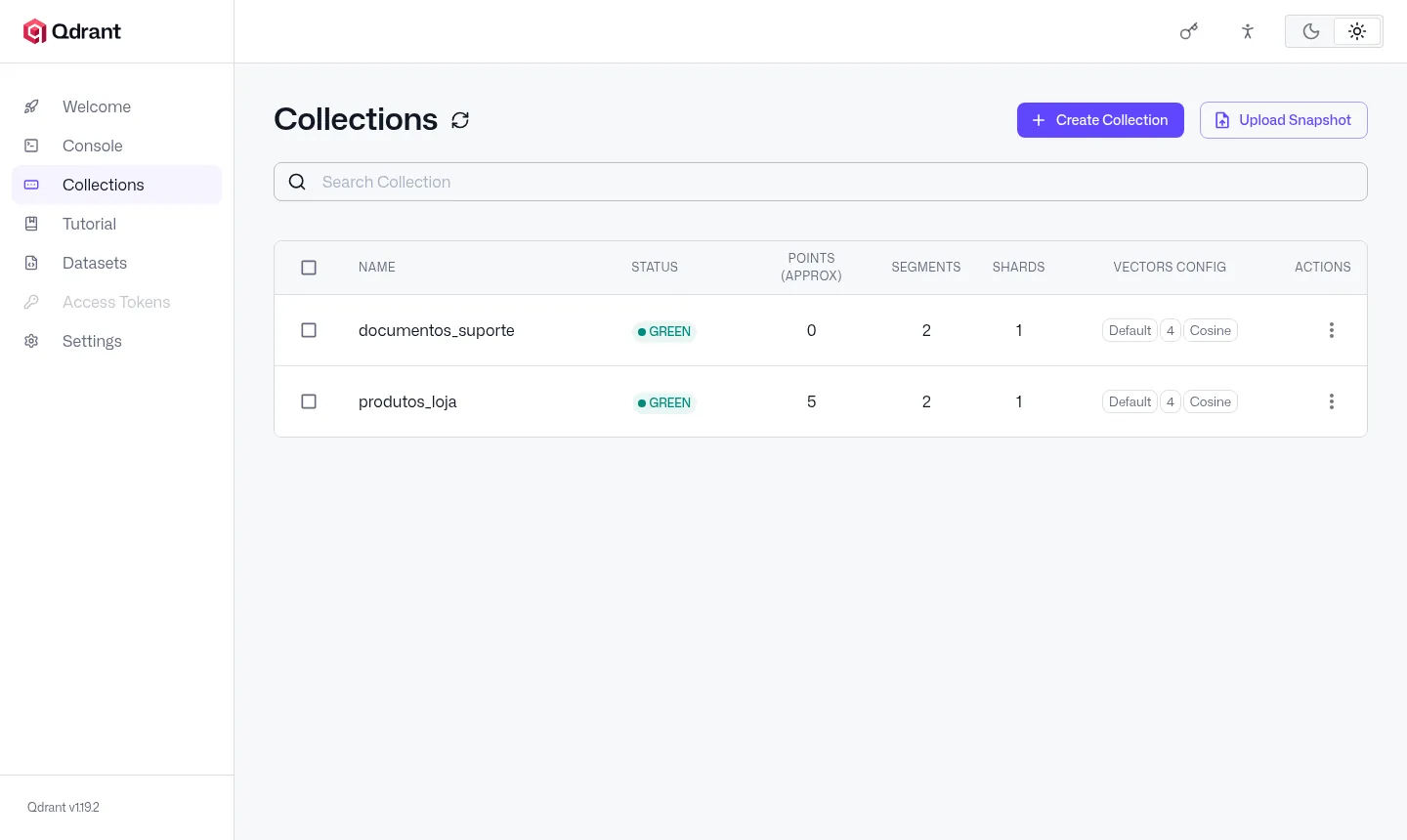
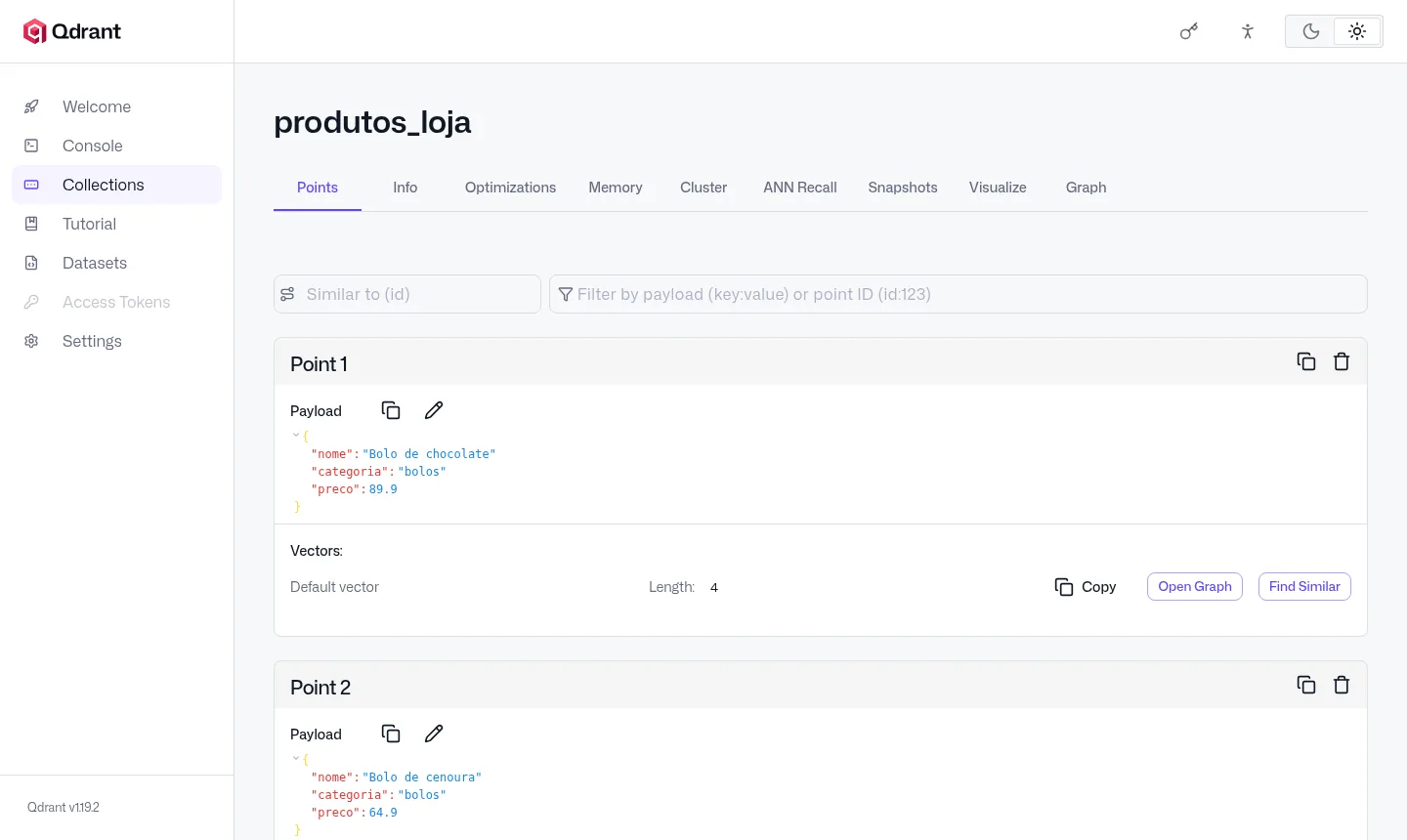
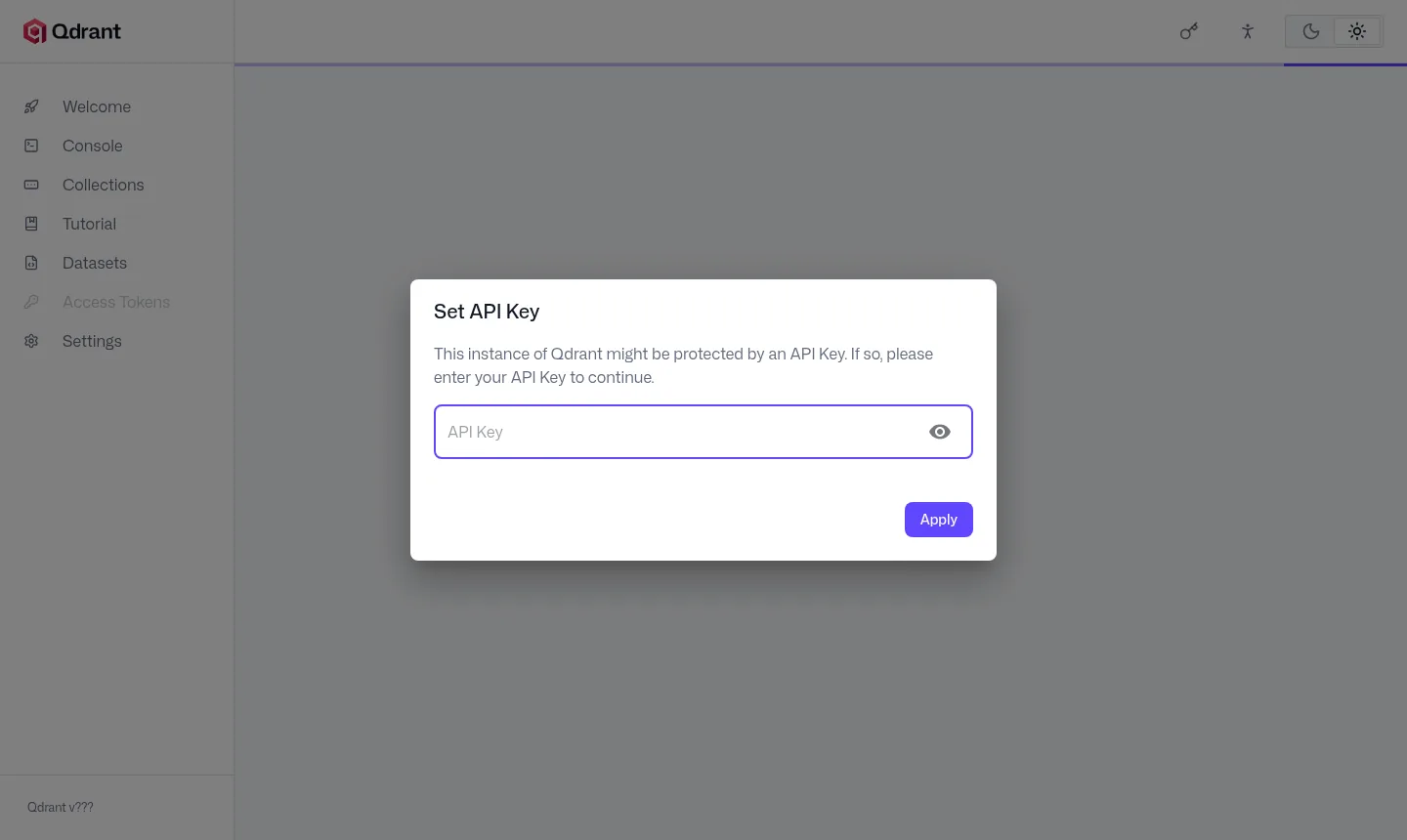
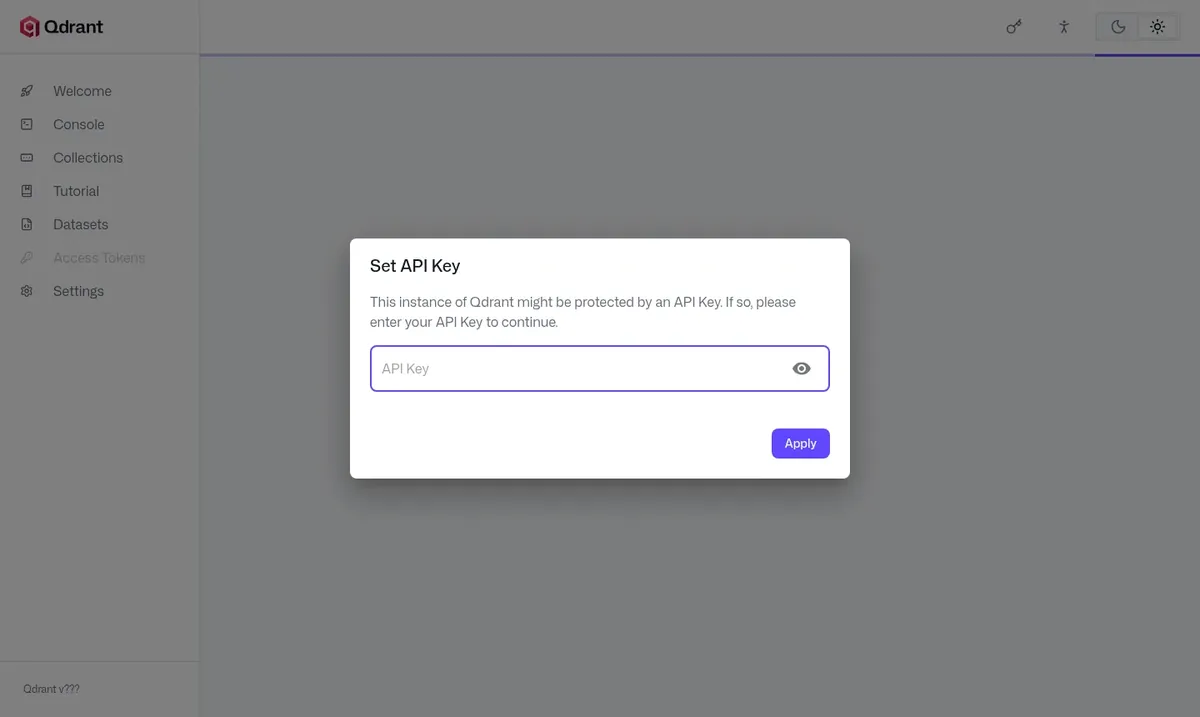
Screenshots taken by the Mega Dedicados team on a test installation, with no customer data.
Your own address with a Let's Encrypt certificate, with no proxy or renewal to manage.
Without the key, the API and the dashboard refuse the connection. The key is generated during installation and belongs only to you.
The Docker container starts by itself if the server reboots.
Ready for the official clients in Python, JavaScript, Go, Rust, Java and .NET.
Browse collections and points and test searches right from your browser.
Qdrant does not send usage data outside your server.
Select Start, Basic, Plus or Pro and choose whether the server is in Rio de Janeiro or São Paulo, Brazil. The price is the same in both.
Pix, card or boleto, on a monthly, semiannual or annual cycle. No lock-in contract.
We create the VPS and install Qdrant with HTTPS automatically, in about 5 minutes.
The address and API key arrive by email and WhatsApp, and you can create your first collection right away.
In our tests, idle Qdrant uses about 90 MB of memory. Real usage grows with the number of vectors and the size of each one.
| Plan | Best for |
|---|---|
| Start 1 vCore · 1 GB | Prototypes, tests and small datasets, with a few thousand documents. |
| Basic 2 vCore · 2 GB | Recommended to get started: an AI assistant in production with a medium-sized dataset. |
| Plus 2 vCore · 4 GB | Qdrant and n8n on the same server, building a complete RAG workflow. |
| Pro 4 vCore · 6 GB | Large datasets with millions of vectors, or several apps sharing the VPS. |
It is an open-source vector database. It stores embeddings and returns the items most similar to a query, which enables semantic search, RAG, recommendations and memory for AI agents.
Qdrant is free, so you only pay for the VPS. The Start plan costs US$ 6.95 per month, and Basic, which we recommend, costs US$ 11.95. Payment is by Pix, card or boleto, with no lock-in and a 7-day refund period.
The app fits in as little as 512 MB of free memory, and idle Qdrant uses about 90 MB. For real use, the Basic plan (2 vCore, 2 GB RAM and 40 GB NVMe) is the safest starting point.
If you want your data on a server you control, in a data center in Brazil and at a fixed cost, yes. You get root access, choose when to update and don't pay per query, since traffic is unlimited.
No. Vectors come from an AI model, such as OpenAI's or a local model. Qdrant stores and searches them, and tools like n8n and LangChain connect the model to the database.
Not without the key. The API and the dashboard require the key generated during installation, which only the customer receives, and the connection uses HTTPS.
Yes. Each app gets its own address on the same VPS, as long as the memory is enough for all of them. For Qdrant and n8n together, the Plus plan is usually the most comfortable.
The installed version is 1.19.2 and it only changes when you decide, via SSH with root access. For backups, use Qdrant snapshots, which copy an entire collection and let you move it to another server. Mega's 24/7 support covers the server side, while Qdrant usage is documented by the project.
Updated on October 19, 2026
 n8nn8n connects apps, APIs and AI models in automated workflows built in a visual editor.
 Evolution APIEvolution API is an open source project that connects WhatsApp numbers to your system via HTTP calls.
 GrafanaSelf-hosted Grafana with no setup: a Cloud VPS with Debian 13, Docker and Grafana 13.2.4 running over HTTP.
Tell us what you want to run and for how many users; we will suggest the plan. The app arrives installed.